Most people have heard "data quality" used as a catch-all phrase, but they've never been given a clear map of what it actually covers. That's what the data quality dimensions framework provides — a structured way to diagnose exactly which aspect of your data is failing and why.
Different frameworks cite different numbers (DAMA uses 6, some enterprise tools use 10 or more), but the core dimensions cover the same ground. Here's what they mean in practical terms.
The Core 10 Dimensions
1. Completeness — The percentage of required fields that actually have values. A contact with no email address is 0% complete for email campaigns.
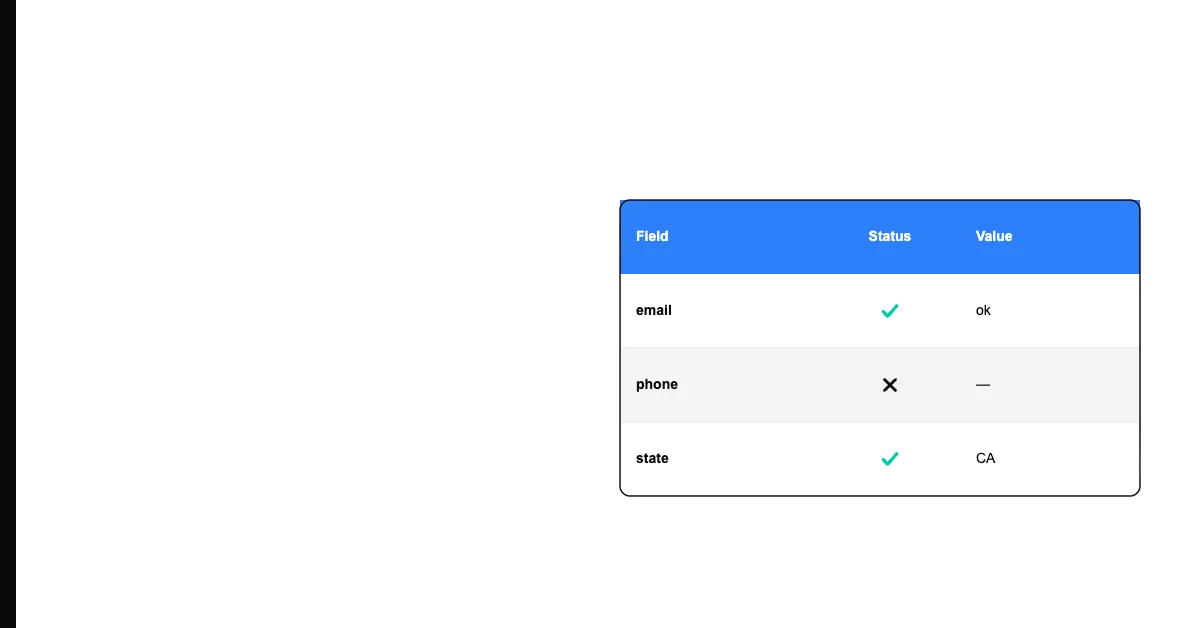
Sohovi profiles every column in your dataset for completeness and flags the exact rows where values are missing — free to try.
2. Accuracy — How closely the data reflects the real-world entity it represents. Wrong phone numbers, misspelled names, and outdated addresses all fail accuracy.
3. Consistency — Whether the same data is represented the same way across all systems. "NY" in one system and "New York" in another creates reconciliation problems.
4. Validity — Whether values conform to defined formats or business rules. A date of "02/30/2024" is syntactically formatted but logically invalid.
5. Uniqueness — The absence of duplicate records. In most systems, each entity (customer, product, transaction) should appear exactly once.
Sohovi automatically finds every duplicate in your dataset — including near-matches — and shows you exactly which rows are affected.
6. Timeliness — Whether the data is current enough for its intended use. Last-year's pricing data used in today's proposals is a timeliness failure.
7. Integrity — Whether relationships between data points are intact and correct. An invoice linked to a deleted customer record is an integrity failure.
8. Conformity — Whether data follows defined standards and formats. Phone numbers that mix formats (+1-555-555-5555 vs. 5555555555) fail conformity.
9. Precision — The level of detail in the data. Coordinates rounded to 2 decimal places vs. 6 decimal places have very different precision for location use cases.
10. Relevance — Whether the data is actually applicable to the current business context. A customer segment built on 3-year-old data may no longer be relevant.
Which Dimensions Matter Most?
That depends on your use case. For email marketing, completeness (email field populated) and validity (email format correct) are paramount. For financial reporting, accuracy and integrity are critical. For CRM-based sales, uniqueness and timeliness matter most.
Starting With the Right Dimension
Rather than trying to score all 10 dimensions at once, identify the one failure mode causing the most pain. Is your team complaining about duplicate records? Start with uniqueness. Are reports mismatching between systems? Start with consistency.
A tool like Sohovi profiles your dataset across all key dimensions at once — upload your CSV and see completeness rates, uniqueness scores, and format validity for every column in seconds.
The dimensions framework isn't academic. It gives you a shared vocabulary for diagnosing data problems and a checklist for declaring your data "fit for purpose." Start there.