You've probably noticed it without naming it: a report that doesn't match reality, a customer list full of duplicates, an import that breaks half your filters. That's a data quality problem.
Data quality is a measure of how well your data serves the purpose it's meant for. Data that's accurate, complete, consistent, and timely is high quality. Data that's missing fields, full of duplicates, or formatted differently across systems is low quality — and it quietly undermines every decision, campaign, and report built on top of it.
Why Data Quality Is a Business Problem, Not Just a Tech Problem
Poor data quality isn't just a nuisance for analysts. IBM estimated the annual cost of bad data in the US at $3.1 trillion (IBM, 2016). For individual businesses, that cost shows up as wasted marketing spend, wrong business decisions, customer churn from bad experiences, and hours of manual reconciliation that never should have been necessary.
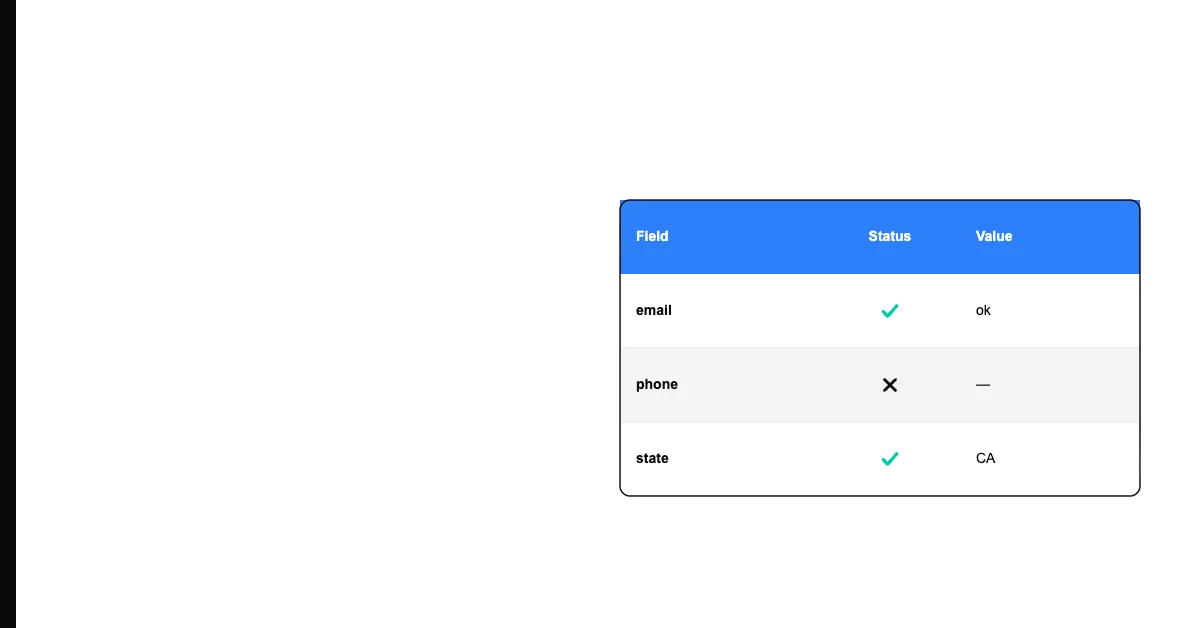
Sohovi shows you exactly what is wrong with your data — completeness gaps, type mismatches, duplicates — in one clear report.
If your team spends time every week "cleaning up" reports, cross-referencing lists, or fixing imports — you have a data quality problem. The question isn't whether to fix it, but where to start.
The Core Dimensions of Data Quality
Data quality is measured across several dimensions. The most commonly used are:
Completeness — Are all required fields populated? A customer record with no email address isn't usable for outreach.
Sohovi profiles every column in your dataset for completeness and flags the exact rows where values are missing — free to try.
Accuracy — Does the data reflect reality? A phone number with 11 digits, a zip code in the wrong format, or a company name that was entered incorrectly all fail the accuracy test.
Consistency — Does the same data point mean the same thing across systems? If your CRM shows "California" and your analytics tool shows "CA", joins between systems will fail.
Validity — Does the data match the expected format or business rules? Dates that look like "2024/13/01" (no 13th month) are invalid.
Uniqueness — Are there duplicate records? Duplicates inflate counts, split engagement history, and cause double-sends.
Sohovi automatically finds every duplicate in your dataset — including near-matches — and shows you exactly which rows are affected.
Timeliness — Is the data current? A last-contacted date from 2 years ago tells you nothing about today's relationship.
How to Assess Your Data Quality Right Now
The fastest way to see where your data quality stands is to profile your most important dataset. Export it as a CSV, then check each column for: how many rows are empty, how many have values in unexpected formats, and how many are duplicates.
This is exactly what Sohovi does — upload your CSV and get an instant breakdown of completeness, uniqueness, and format issues across every column, entirely in your browser. Your file never leaves your machine.
Where to Start
Don't try to fix everything at once. Pick the dataset that matters most to your business right now — your customer list, your pipeline, your product catalog — and run a quality check on it. You'll find issues you didn't know existed, and you'll have a clear starting point for improvement.
Data quality isn't a one-time project. It's an ongoing practice. The businesses that compete on data aren't the ones with the biggest datasets — they're the ones with the cleanest.