Sales reps' time is the most expensive resource in most companies. And a significant portion of that time is spent on data-related overhead: deduplicating leads, chasing down correct contact information, reconciling duplicate opportunities, updating records that weren't maintained. Every hour spent on bad data is an hour not spent selling.
This post covers where CRM data quality fails sales teams most often, what it costs in real terms, and what sales operations can do to maintain cleaner data without adding admin burden on reps.
Where CRM Data Quality Fails Sales Teams
Duplicate Leads and Contacts
Duplicate records are the most universal CRM data quality problem. They're created through: multiple marketing platform integrations that don't deduplicate on import, reps entering a new lead for a prospect who already exists, and two leads from the same company created without linking them to the same account.
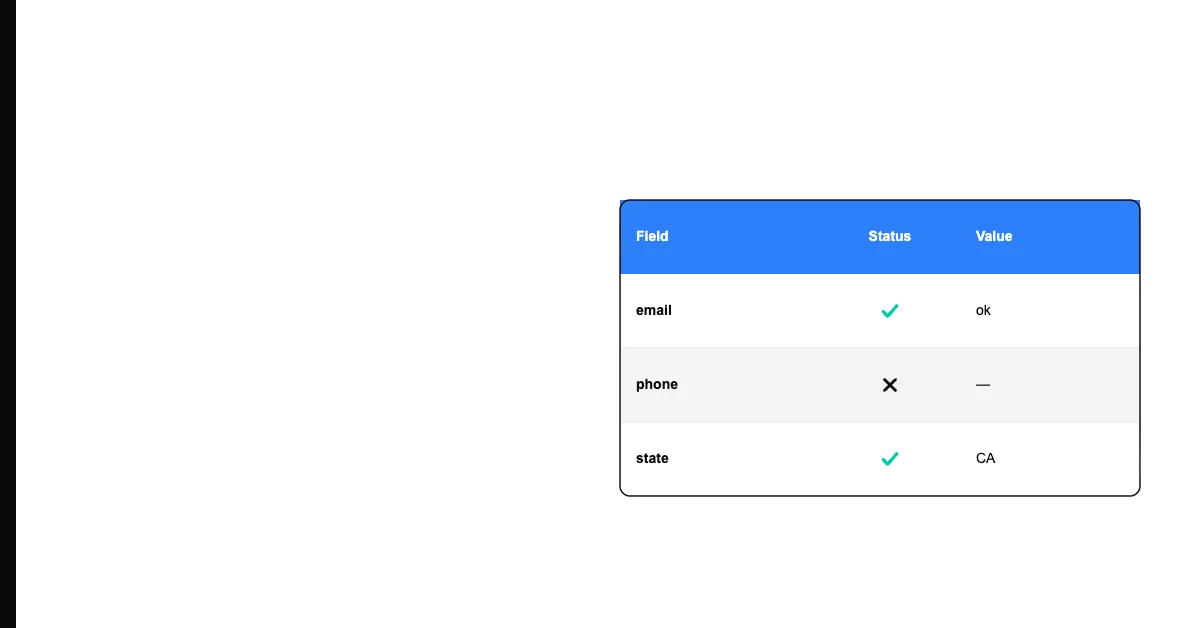
Sohovi automatically finds every duplicate in your dataset — including near-matches — and shows you exactly which rows are affected.
The consequences for sales teams: two reps contact the same prospect and both get an awkward "I already spoke to someone from your company" response. An account manager misses an expansion signal because the usage data is attributed to a duplicate account. Pipeline forecasts show more opportunities than actually exist.
Industry estimates suggest that enterprise CRMs average duplicate rates of 10–30% in active contact databases, depending on the age and size of the database.
Stale Contact and Account Data
B2B contact data decays at roughly 30% per year. People change jobs, companies update phone numbers, and businesses get acquired, renamed, or shut down. A CRM that hasn't been cleaned in 12–18 months likely has a substantial portion of contacts where the role, phone number, or email no longer applies.
Sohovi finds gaps, duplicates, and format errors in your CRM data — so your team is working from records they can trust.
Reps who dial through a stale territory list are wasting call time on numbers that don't reach the right person. Reps who send email sequences to outdated addresses waste their best touches on contacts who can't receive them.
Incomplete Opportunity Records
Pipeline forecasting depends on complete opportunity records: stage, close date, amount, next step, and deal notes. When any of these are consistently empty — because reps skip them, because the CRM doesn't require them, because data entry is done after the fact — pipeline reports misrepresent expected revenue.
Common problems:
- Close dates extended perpetually without a stage change
- Pipeline value at $0 because the amount was never entered
- No next step logged, making it impossible to distinguish active from stagnant opportunities
- Duplicate opportunities for the same deal created by different reps or different marketing attributions
Poor Account Hierarchy
In B2B sales, account hierarchy — understanding which contacts belong to which companies, and which companies belong to which enterprise parents — is critical for enterprise deal management. When account hierarchy is wrong or missing (contacts floating without a company, subsidiaries not linked to parent accounts), territory management is unreliable and ABM targeting is impossible.
Practical Steps for Sales CRM Data Quality
1. Run a monthly duplicate lead and contact audit. Set up an automated duplicate detection report in your CRM or run a manual CSV export deduplication check. Focus on contacts with the same email domain and similar names. A monthly cadence catches accumulating duplicates before they compound.
2. Enforce required fields for opportunity progression. Make close date, amount, and next step required before a rep can advance an opportunity to the next stage. Required fields are the most effective CRM data quality control for active pipeline data.
3. Set up an automated data staleness alert. Flag contacts that haven't been updated in 12 months with a "Verify Contact Data" task. Assign those tasks during slow periods. Most reps find that 20–30% of flagged contacts need updating.
4. Validate leads at import. Before any marketing-generated lead list is loaded into the CRM, run a basic quality check: valid email format, no duplicates against existing records, company name populated. This prevents a significant category of CRM quality problems at the source.
5. Link all contacts to accounts. A contact record without an account association is invisible to territory management, ABM programs, and account-level reporting. Set a required account association for any contact being worked by a rep.
Frequently Asked Questions
Q: What are the most common CRM data quality problems for sales teams? Duplicate leads and contacts, stale B2B contact information, incomplete opportunity records (missing close date, amount, or next step), and poor account hierarchy (contacts not linked to the right accounts) are the most common CRM data quality problems.
Q: How much time do sales reps waste on bad CRM data? Salesforce research suggests that sales reps spend 20–30% of their time on non-selling activities, with data-related overhead a significant component. Even conservatively, if reps spend 1 hour per week on data cleanup and reconciliation, that's 50 hours per year per rep — at sales rep fully-loaded costs, a significant number.
Q: How do duplicate CRM records affect pipeline forecasting? Duplicate opportunity records inflate expected pipeline value, making revenue forecasts overstate expected bookings. Teams hire and plan to revenue that doesn't materialize — and when it misses, the cause is often attributed to execution failure rather than the data quality problem that produced the inflated forecast.
Q: What is B2B contact data decay and why does it matter for sales teams? B2B contact data decays at roughly 30% per year because people change jobs, get promoted, change phone numbers, and companies get acquired or renamed. A CRM not cleaned in 18 months has a substantial portion of contacts who can no longer be reached at the stored contact information.
Q: How should sales teams handle lead deduplication from marketing campaigns? Every marketing lead import should include a deduplication check against existing CRM records (by email) before the import completes. Most CRMs have configurable duplicate detection — enabling it prevents the most common import-related duplicates. For platforms that don't, run a manual deduplication check on the import file before loading.
Q: What CRM fields should be required for all opportunities? Close date, estimated value, and current stage are the minimum required fields for pipeline reporting to be reliable. Next step and owner are important for active pipeline management. Making these required before stage advancement enforces data entry discipline at the point of progression.
Q: How does account hierarchy data quality affect sales operations? Poor account hierarchy makes territory management unreliable (contacts in the wrong territory), ABM targeting impossible (can't target a company if its contacts aren't linked to the right account), and enterprise deal management difficult (can't track all stakeholders if they're split across disconnected contact records).
Q: How can sales ops reduce the data maintenance burden on reps? Automate what can be automated: duplicate detection at import, contact update reminders for stale records, required field enforcement at stage transitions. Reps should do data entry once and accurately — not spend time on manual cleanup of problems that automation could have prevented.
Q: What is the relationship between CRM data quality and sales forecast accuracy? Sales forecast accuracy depends on accurate pipeline data: correct amounts, correct close dates, correct stages. When pipeline records have wrong amounts, perpetually extended close dates, or duplicate entries, the forecast is systematically wrong. CRM data quality is the foundation of reliable revenue forecasting.
Q: How often should sales teams run a CRM data quality audit? Monthly for a quick duplicate check and stale opportunity review. Quarterly for a more comprehensive audit: contact completeness, account hierarchy gaps, field consistency. Before any significant business event (annual planning, board presentation, major hiring decision) that depends on CRM data.
Clean CRM data isn't about making the database pretty — it's about giving your reps reliable information and giving your forecasts a foundation they can actually be held to.