Marketing teams are often the first to feel the consequences of bad data — and the last to be given tools to fix it. A campaign that bounced. A segment that reached the wrong audience. Attribution reporting that credited the wrong channel. Personalization that used the wrong name.
Every marketing failure has an upstream cause. For a significant portion of underperforming campaigns, that cause is data quality. This post shows you exactly where marketing data quality fails and how to address it before it drains your next campaign budget.
Where Marketing Data Quality Fails
Email List Decay and Deliverability
Email marketing is the clearest example of data quality having a direct revenue consequence. ZeroBounce's research puts natural email list decay at 22–25% per year. A list that was clean 18 months ago has lost a quarter of its deliverable contacts — contacts you're still paying to store, segment, and send to.
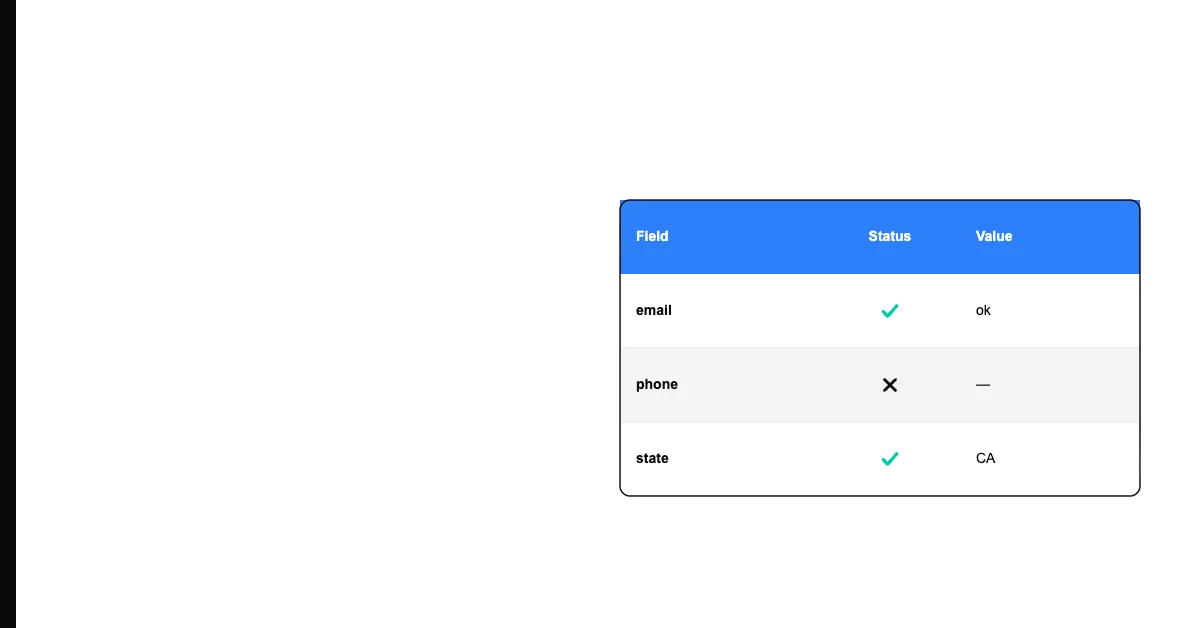
Sohovi validates your email list for invalid formats, duplicates, and missing fields before you send — protecting your sender reputation.
The deliverability consequence is worse than the wasted send cost. A hard bounce rate above 2% damages your sender reputation with inbox providers. Emails to valid, engaged subscribers start landing in spam. Your entire email program underperforms because of list quality problems.
Segmentation Accuracy
Your segments are only as accurate as the data fields they're built on. A segment of "enterprise customers in the technology industry" is meaningless if 25% of your customer records have no industry tag, or if "technology" appears as "Tech", "Technology", "tech industry", and "Software" across different records.
This creates a common invisible problem: you define a segment, run a campaign, see mediocre results, and conclude the message didn't land — when the real issue is that 30% of your intended audience was excluded because their records didn't match the filter.
Attribution and Reporting Accuracy
Marketing attribution models require consistent, complete data across your CRM, marketing automation, web analytics, and ad platforms. When the same contact is represented differently across these systems — different email formats, different company names, different lifecycle stage values — attribution joins fail silently.
Sohovi finds gaps, duplicates, and format errors in your CRM data — so your team is working from records they can trust.
The result: conversions go unattributed, channels that drove pipeline get undercredited, and budget decisions are made on a distorted picture of what's actually working.
Contact Record Completeness for Personalization
Modern marketing depends on personalization. Personalization depends on data. When key fields like first name, company, job title, industry, and product usage are missing or wrong, personalization breaks — either obviously (a merge failure) or subtly (the wrong industry vertical in a B2B nurture sequence).
Practical Steps for Marketing Data Quality
1. Run an email list health check before every major campaign. Check bounce rate history from your email platform. Validate your list against email syntax rules. Remove hard bounces before they compound into a sender reputation problem.
Sohovi lets you set up validation rules for any column and instantly see which rows fall outside them — no code or SQL required.
2. Audit your segmentation fields for completeness. For your three most-used targeting fields (industry, company size, lifecycle stage), calculate the null rate. Any field below 85% completeness is degrading your segment accuracy.
3. Standardize field values for categorical fields. If your industry field has 47 distinct values when you only have 12 industries, you have a data entry consistency problem. Standardize to an approved list and enforce it going forward.
4. Reconcile your CRM and MAP contact counts. If the number of contacts in your CRM differs significantly from your marketing automation platform, you have sync or join failure issues affecting attribution. Identify the gap before your next QBR.
5. Build a pre-campaign data quality gate. Before any major campaign send, run a five-minute quality check: bounce rate, segment completeness, merge field null rates. Make it a checklist that must be signed off before the campaign launches.
Frequently Asked Questions
Q: What are the most important data quality checks for marketing teams? Email deliverability (bounce rate and list validity), segmentation field completeness (null rates on targeting fields), attribution data consistency (contact representation across CRM and MAP), and personalization field accuracy (merge field null rates on key fields) are the most important marketing data quality checks.
Q: How does email list quality affect marketing ROI? Poor list quality reduces deliverability (more emails land in spam), inflates list size metrics (making performance look worse than it is), wastes send budget (sending to contacts who can't receive emails), and corrupts engagement benchmarks. All four effects reduce the return on every campaign dollar.
Q: What is an acceptable email hard bounce rate for a marketing team? Industry best practice is below 0.5% for a well-maintained list. Above 2%, your sender reputation begins to degrade and you should prioritize list hygiene before your next major send. Above 5%, inbox providers may start filtering all your email to spam, not just the bouncing ones.
Q: How does poor segmentation data quality affect campaign performance? Poor segmentation data quality silently excludes records from your intended audience. A campaign that targets "enterprise technology customers" but has a 25% null rate on the industry field is only reaching 75% of its intended audience. The remaining 25% isn't reached but isn't tracked as excluded — it simply doesn't appear in the results.
Q: How does marketing data quality affect attribution modeling? Attribution models depend on consistent contact representation across all systems. When contacts are represented differently in your CRM, MAP, and web analytics, conversion attribution breaks. Some conversions go unattributed. Some channels get undercredited. Budget decisions built on this attribution systematically defund what's actually working.
Q: What is a marketing data quality gate? A marketing data quality gate is a pre-campaign checklist that must be completed and signed off before a campaign launches. It typically covers: list bounce rate check, segmentation field completeness review, merge field null rate check, and attribution join verification. It's the marketing equivalent of a pre-flight check.
Q: How should marketing teams handle contact records from multiple sources? Establish a deduplication and normalization process for any new contact source before loading contacts into your main database. Check for duplicates against existing records (by email), standardize field values (industry, company size, lifecycle stage) to your approved vocabulary, and validate email format before adding to any list.
Q: Can bad data quality explain why a well-designed campaign underperformed? Yes — and this is one of the most commonly missed root causes in marketing post-mortems. Before concluding that a campaign underperformed because the message was wrong, check whether the data quality of the audience was the real cause: segment completeness, list bounce rate, and attribution accuracy.
Q: How often should marketing teams run data quality audits? A light audit (bounce rate check, segment field completeness review) before every major campaign. A deeper audit (full contact database completeness and deduplication) quarterly. A CRM-MAP reconciliation monthly.
Q: What's the most common marketing data quality mistake? Ignoring list hygiene until deliverability visibly degrades — by which point the sender reputation damage is already done and recovery takes months. The best time to clean your email list is before the problem shows up in bounce rates, not after.
Marketing data quality isn't a one-time project — it's a pre-campaign habit. A 15-minute quality check before every major send prevents the kind of deliverability damage that takes months to repair.
If you're ready to run a quick quality check on your contact list or campaign audience, Sohovi is free to try. Upload your CSV and get an instant report — invalid emails, duplicates, completeness rates — in under a minute. No credit card, no code required.