A wrong decimal point. A duplicate transaction. A client account linked to the wrong risk profile. In financial services, data quality errors don't just create operational friction — they produce incorrect reporting, trigger compliance failures, and in some cases move real money in the wrong direction.
This post covers where financial services data quality problems concentrate most, what the regulatory implications are, and what firms of any size can do to improve accuracy without a data engineering team.
Where Financial Data Quality Fails Most
Transaction Data Errors
Transaction records are the foundation of financial reporting. Duplicate transactions inflate revenue and expense figures. Transactions posted to the wrong account distort P&L statements. Mismatched transaction dates cause reconciliation failures that take hours to untangle.
Sohovi automatically finds every duplicate in your dataset — including near-matches — and shows you exactly which rows are affected.
For small accounting firms and financial advisors, these problems often trace back to manual data entry, inconsistent chart of accounts usage, or imports from client systems that weren't validated before loading.
Client and Account Data Errors
Inaccurate client data — wrong addresses, outdated KYC information, incorrect risk tolerance classifications — creates both operational and regulatory problems. A client receiving communications at a wrong address is an operational failure. A client account linked to an outdated risk profile is a suitability compliance issue.
Under regulations like MiFID II (EU) and Reg BI (US), financial services firms must demonstrate that their recommendations are suitable for each client. Suitability depends on accurate client data.
Reference Data Errors
In financial services, reference data — instrument identifiers (ISIN, CUSIP), currency codes, exchange codes — forms the backbone of every trade, valuation, and report. Inconsistent or incorrect reference data causes valuation errors, failed settlements, and reporting discrepancies.
Even small firms using off-the-shelf investment platforms can encounter reference data quality problems if their internal data doesn't cleanly map to the identifiers used by their data providers.
Reporting Data Errors
Regulatory reports (FINRA, SEC, FCA, ESMA) depend on the accuracy of the data feeding them. A 13F filing with wrong position sizes. A suspicious activity report linked to the wrong account. An AML check run on a client whose identity data was entered inconsistently across systems.
Sohovi scores your dataset against your own accuracy standards and highlights the columns and rows where values fall outside expected ranges.
Regulatory reporting errors, even when unintentional, can trigger examinations, corrective filings, and in serious cases, enforcement action.
Key Data Quality Dimensions for Financial Services
Accuracy: Do transaction amounts, dates, and account identifiers reflect what actually occurred? For financial data, accuracy is the non-negotiable baseline.
Completeness: Are all required fields populated? Missing counterparty information, missing tax IDs, missing instrument identifiers all create downstream problems in reporting and reconciliation.
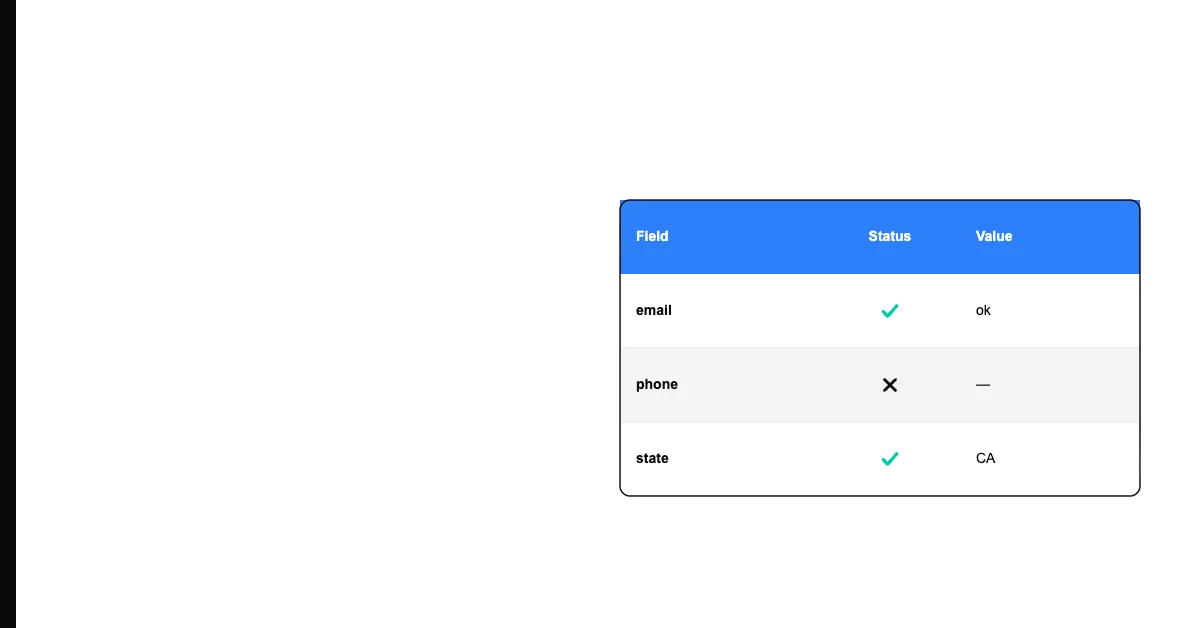
Sohovi profiles every column in your dataset for completeness and flags the exact rows where values are missing — free to try.
Consistency: Is the same account, client, or instrument represented the same way across all systems — front office, back office, risk, and compliance? Inconsistencies between systems create reconciliation failures.
Timeliness: Is the data current? For market risk and regulatory reporting, stale data produces wrong conclusions and potentially wrong decisions.
Practical Steps for Small Financial Services Firms
1. Validate transaction data before posting. Run a completeness and format check on any transaction file before it's posted to your accounting system. A missing account code, a duplicate transaction reference, or a date format error caught at this stage takes minutes to fix; found in a completed financial statement, it takes hours.
2. Audit client records for KYC completeness. Identify clients whose required KYC fields (date of birth, address, tax ID, risk classification) are incomplete or stale. This is both a regulatory obligation and an operational protection.
3. Standardize your chart of accounts usage. Inconsistent use of account codes — booking similar transactions to different accounts across periods — is one of the most common causes of variance analysis surprises and audit findings.
4. Reconcile before you report. Before any regulatory or client report is published, reconcile the source data to the expected totals. A one-line reconciliation check (does total reported AUM match your custody records?) catches most material errors before they reach the regulator or client.
Frequently Asked Questions
Q: What are the most common data quality problems in financial services? Duplicate transactions, missing or incomplete client records (especially KYC fields), inconsistent account coding across periods, and reference data mismatches between internal and provider systems are the most common. Each creates downstream problems in reporting, reconciliation, and compliance.
Q: Why does data quality matter for financial regulatory compliance? Regulatory reports — SEC filings, FINRA reports, AML/KYC documentation, suitability records — must accurately reflect a firm's positions, transactions, and client relationships. Inaccurate underlying data produces inaccurate reports. Even unintentional reporting errors can trigger regulatory examinations and corrective filing requirements.
Q: What is the financial cost of poor data quality in financial services? The direct costs include: reconciliation labor (analysts spending hours resolving discrepancies), failed settlement fees, and regulatory fine exposure. The indirect costs include client trust damage when errors reach account statements, and audit overhead when inaccurate records require explanation.
Q: How does data quality affect financial risk management? Risk models are only as accurate as the data feeding them. Position data with duplicate entries overstates exposure. Stale market data produces wrong valuations. Inconsistent counterparty data prevents accurate concentration risk analysis. Poor data quality in risk management means the firm may be managing to a picture of risk that doesn't match reality.
Q: What data quality checks should run before any financial reporting cycle? Before any reporting cycle: verify transaction completeness (all periods covered, no gaps), check for duplicate transaction references, confirm account code consistency with prior periods, reconcile source data totals to custody or clearing records, and validate any external data feeds against your expected formats.
Q: How does data quality affect financial audits? Auditors test whether financial records accurately represent the underlying economic activity. Data quality failures — duplicate transactions, misclassified expenses, incomplete documentation — create audit findings that require management response, restatement, and in some cases, qualified audit opinions.
Q: What is reference data and why does it matter for financial data quality? Reference data is the standardized identifiers and classifications used across financial systems — ISIN codes, CUSIP numbers, currency codes, exchange identifiers. When reference data is inconsistent or incorrect, trades fail to settle, valuations are wrong, and cross-system reconciliations break.
Q: Can small financial advisory firms afford to prioritize data quality? They can't afford not to. Small firms typically have less operational buffer than large institutions — a data quality failure that causes a wrong client statement or a delayed regulatory filing has outsized impact. The good news: the most important checks (transaction deduplication, KYC completeness, account code consistency) are achievable without enterprise tools.
Q: How should a financial services firm start improving data quality? Start with the data that feeds your most important deliverable — whether that's client reporting, regulatory filing, or internal financial statements. Profile that dataset for completeness and consistency issues first. Then build a pre-process validation step that runs before each reporting cycle.
Q: What is the relationship between data quality and financial fraud detection? Clean, consistent data makes anomalies visible. Duplicate transactions, unusual patterns in account codes, and inconsistent counterparty data are often early indicators of errors — or fraud. Firms with high data quality baselines detect anomalies faster because the signal-to-noise ratio is better.
In financial services, data quality is a fiduciary obligation, not just an operational efficiency. Start with the dataset that feeds your most important report — whether that's client statements, regulatory filings, or your own P&L — and validate it before it becomes a finding.