Why Marketing Teams Own CRM Data Quality
CRM data quality is typically owned by sales or operations — but marketing teams are the primary victims of CRM data problems. Your email campaigns bounce. Your segments don't exclude the right people. Your attribution is wrong because lead sources were captured inconsistently.
Marketing teams that don't actively participate in CRM data hygiene pay for others' data problems with their own campaign performance.
The Four Biggest CRM Data Problems for Marketing
1. Duplicate contacts The same person with three records: one from a webinar registration, one from a trade show import, one from a direct sales entry. Your marketing campaigns now reach them three times — tripling your unsubscribes and distorting your engagement metrics.
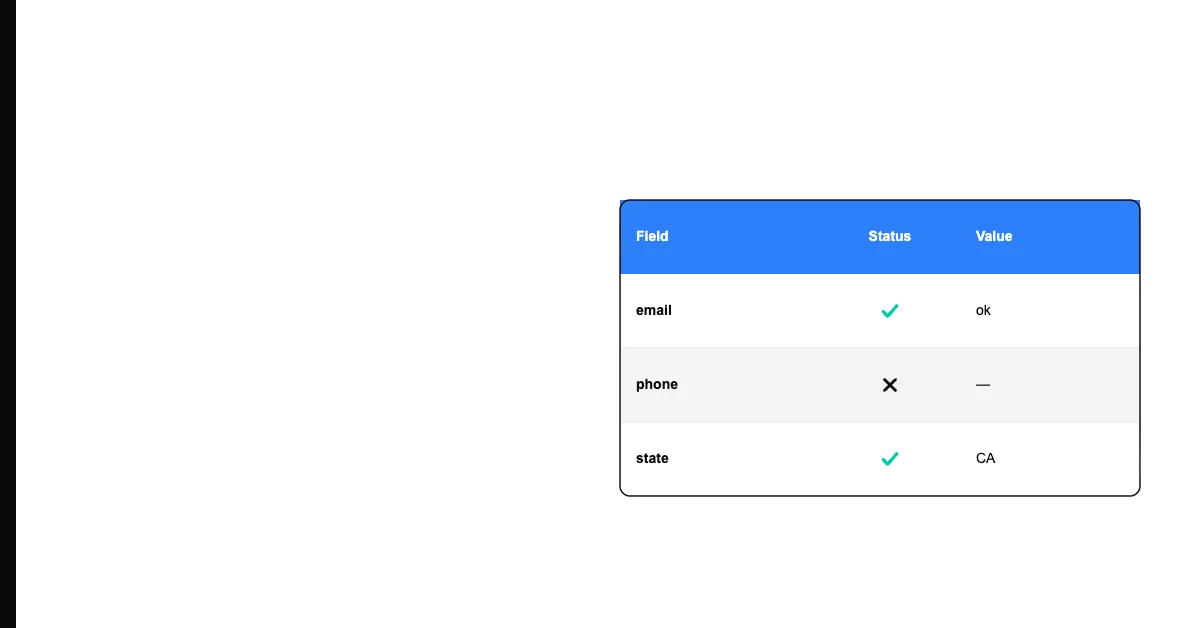
Sohovi automatically finds every duplicate in your dataset — including near-matches — and shows you exactly which rows are affected.
2. Stale or inactive records People who haven't opened an email in 18 months, or whose companies have been acquired. Emailing them drags down your engagement rates and signals to ESPs that you're sending to uninterested contacts — hurting deliverability for everyone on your list.
3. Missing or inconsistent lead source Records with no lead source, or lead source entered as free text ("met at conference in Chicago 2024") instead of a standard code. You can't analyze your marketing channel effectiveness if lead source is captured inconsistently.
4. Wrong or outdated email addresses People who changed jobs (common for B2B), people who gave a junk email at signup, people whose companies' email domains changed due to acquisitions.
The Monthly CRM Hygiene Session
Schedule 2 hours once a month:
Week 1: Deduplication Run your CRM's merge suggestions or export contacts and sort by email to find exact duplicates. Merge duplicate records, keeping the most complete version.
Week 2: Re-engagement and suppression Identify contacts with no email activity in 12+ months. Run a re-engagement campaign. Suppress anyone who doesn't engage after two re-engagement attempts. Move them to a suppressed segment rather than deleting (for CAN-SPAM record requirements).
Week 3: Field standardization Review lead source values and standardize: map free-text variations to canonical codes. Update any phone numbers to consistent format. Remove punctuation from company names that breaks personalization.
Week 4: Data enrichment For your top 20% of contacts by potential value, verify employment status and email validity. One hour of enrichment on high-value records prevents significant waste in targeted campaigns.
Getting Buy-In From Sales and Ops
Frame CRM hygiene as a revenue problem, not a data problem:
Sohovi finds gaps, duplicates, and format errors in your CRM data — so your team is working from records they can trust.
"Our current CRM has 1,400 duplicate contacts. Our email campaigns reach 32% of our list — likely because 20%+ of addresses are stale or duplicated. Cleaning this data would recover approximately 200 contacts we're currently missing and improve deliverability across all campaigns."
Numbers make the case. Abstractions don't.